


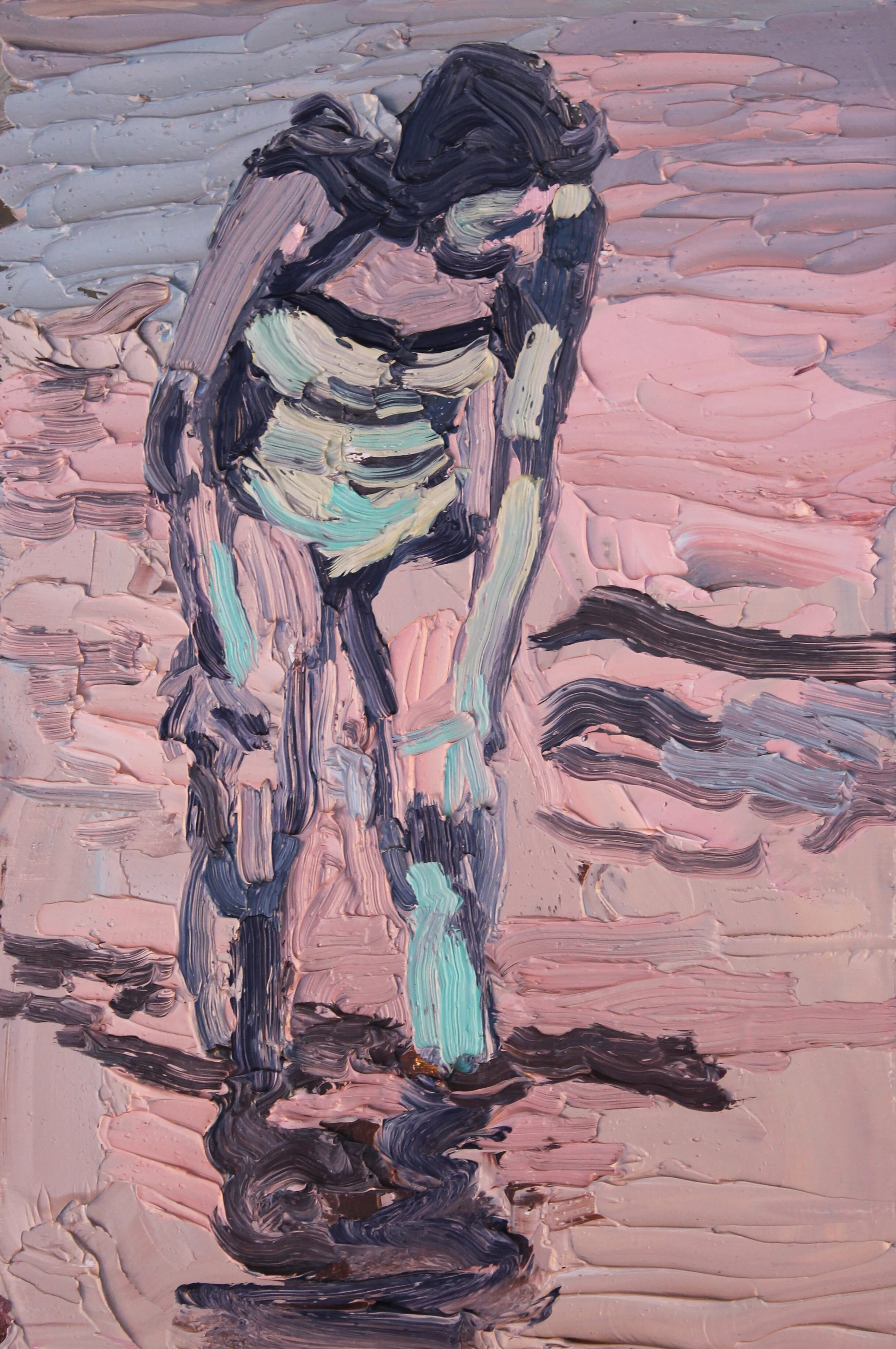


Oil on wood panel
Oil on wood panel, framed
80 x 100 x 2.5 cms
“It is the biggest window in the house and the one that lets in the most light. Sun coming in, green lit bushes glowing outside contrast with the dark purple - grey of the walls and the metallic blue of the sink, even the old milky baby bottle looks alright.
At the beginning, when being at home all the time was new to me, the kitchen sink was a place for dreaming, in spite of its boringness, the light bouncing off the cupboard turns the renters magnolia off-white into a flat violet with hints of red.”
Emma Copley, from notes on paintings
Oil on wood panel
40 x 30 x 2 cms
Selected for Lynn Painters Stainers Exhibition Mall Galleries London
Oil on wood panel
46 x 30 x 2 cms
Sold
24 Portraits: Recovering and Reimagining Women’s Labour
2019-2020
Oil on perspex
154 x 131 cms (individual panels 30 x 21 cms)
Supported by The Rising Tide: Women at Cambridge programme hosted by Cambridge University Libraries, supported by Cambridge Assessment, Vice Chancellor of the University of Cambridge, Howard and Abby Milstein Foundation, and Friends of Cambridge University Library. Permanent Collection University of Cambridge, Pathology Department.
“This site-specific installation is made up of painted portraits of women who currently work in all areas of the Department of Pathology at the University of Cambridge including laboratory managers, academics, cleaners, lecturers, administrators and technicians.
My aim is to celebrate and address the representation of women working in all types of jobs in this department. After researching how many women work in the Department of Pathology, and what that work entails; I photographed a small selection of them and from these photographs created a series of 24 painted portraits. The portraits are painted in black paint on transparent Perspex and installed in a large window. The light coming in the window allows the image to be seen, similar to images created in stained glass.
By creating these paintings that represent women carrying out all forms of labour in the department, I intended to elevate these sometimes undervalued images of women and their job roles. By placing the portrait installation in between the existing commemorative bronze relief portraits of men, I wanted to create visual connections between both sets of images, enabling the viewer to confront the visual representation of women in the department.
The title of this installation piece relates directly to Gerhard Richter’s 48 Portraits; a series of painted portraits of historic male figures made for the 1972 Venice Biennale. Richter was interested in the speechless language of pictures, where personalities become anonymous. This is something I am interested in also and wanted to make a point of with the title of the piece. By painting the portraits of these women in black and white and not including visual information that would point to their specific job role, I hope to have given them this anonymity and even the ability to be reimagined.”
Emma Copley
Free and open to all. Visitors must check in at the ground floor for a visitors pass and be escorted to view the art work. Large groups please call in advance. Contact details are available on the Department of Pathology website.
Best Friend
2018
Oil on wood panel, framed
53 x 43 x 2.5 cms
“Soon it will be summer. Light grey skies, cold blue waves with pink foam and the smell of salty air. My loves and I spend these short times together with sea water stinging eyes, feeling our way around. Completely taken over by the splash.”
Emma Copley, from notes on paintings
My little swimmer
2018
Oil on wood panel, framed
53 x 43 x 2.5 cms
Winner of The Other Art Fair x Habitat Award
Habitat AW18 Collection 2018
“I have always admired the impressionist’s ability to capture a fleeting moment. I worked very quickly laying oil paint onto a wood panel with a palette knife. Using a family photo as a starting point, and mixing colour that reflects how I imagine my daughter might feel when she enters the water. I wanted her figure to just begin to emerge and for the work to express not only an emotion with the combination of gesture and colour, but also a sense of speed.”
Emma Copley